



Break your script into smaller, reusable functions or modules. This keeps your code organized and makes it easier to test, update, or reuse across projects. Create separate files for utility functions. Use parameters instead of hardcoding values. Keep one function focused on a single task.
Background and Context
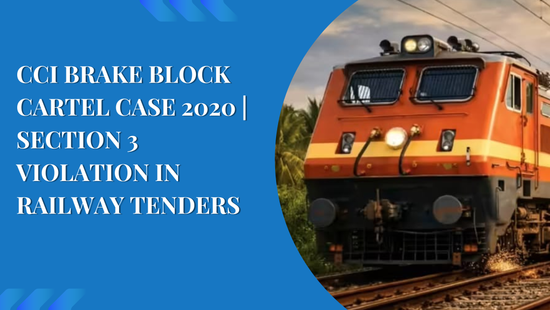
The Competition Commission of India passed a significant order on 10.07.2020 against 12 manufacturers of Composite Brake Blocks for indulging in cartelization in tenders floated by Indian Railways. This case is an important example of how CCI is monitoring public procurement to ensure that taxpayer money is not wasted due to anti-competitive conduct. The matter came before CCI through references filed under Section 19(1)(b) of the Competition Act, 2002 by various Railway zones across India.
The Informant Parties in this case were the Chief Materials Manager of South Eastern Railway, Controller of Stores of Central Railway, Chief Materials Manager of Eastern Railway, Chief Materials Manager-I of North Western Railway and Chief Materials Manager-Sales of North Western Railway. These references were filed against 12 Opposite Parties who are all RDSO approved vendors for Composite Brake Blocks.
The Opposite Parties include Hindustan Composites Limited, Industrial Laminates India Private Limited, BIC Auto Private Limited now known as Masu Brake Pads Private Limited, Escorts Limited Railway Equipment Division, Rane Brake Lining Limited, Om Besco Super Friction Private Limited, Cemcon Engineering Co Private Limited, Sundaram Brake Lining Limited, Bony Polymer Private Limited, Daulat Ram Brakes Manufacturing Company, Hindustan Fibre Glass Works and Precision Industrial System. Indian Railways procure various types of brake blocks for their train operations and as per Railway policy only RDSO approved vendors are eligible to participate in these tenders.
The core allegation was that these manufacturers colluded with each other while submitting bids for Railway tenders. It was alleged that there was coordination on pricing, allocation of tenders among themselves and submission of cover bids to create a false impression of competition. The Director General of CCI conducted a detailed investigation into these allegations and submitted a report to the Commission. The DG report contained evidence which suggested that the Opposite Parties were acting in concert and not competing independently in the tender process.
CCI had to decide two main issues in this case. The first issue was whether the Opposite Parties had contravened the provisions of Section 3(3) of the Competition Act, 2002. The second issue was regarding the liability of individuals and officials of the Opposite Parties under Section 48(1) or 48(2) of the Act. After hearing the arguments of both sides and examining the DG report, CCI proceeded to analyze the evidence on record.
On the first issue, CCI held that OP-1 to OP-10 had violated Section 3(3)(a), Section 3(3)(c) and Section 3(3)(d) read with Section 3(1) of the Competition Act, 2002. Section 3(3)(a) prohibits agreements which directly or indirectly determine purchase or sale prices. CCI found that there was evidence of parallel pricing and coordination among the Opposite Parties. Section 3(3)(c) prohibits agreements for allocation of tenders or sources of supply. CCI found that the tenders were being allocated among the cartel members. Section 3(3)(d) prohibits bid rigging or collusive bidding. CCI found that cover bids were being submitted to make it appear that there was competition. Under Section 3(3) of the Act, such agreements are presumed to have an appreciable adverse effect on competition in India. Therefore, it was not necessary for the Railways to separately prove the adverse effect on competition.
On the question of remedy, CCI passed an order under Section 27(a) of the Act. CCI directed the officials of the Opposite Parties to cease and desist from indulging in such practices in the future. However, CCI took a lenient view on the question of monetary penalty. The Commission noted that many of the Opposite Parties are Micro Small and Medium Enterprises. The order was passed in July 2020 during the COVID-19 pandemic. Considering the adverse economic situation and the impact on MSMEs, CCI in the interest of justice decided not to impose any monetary penalty on these companies. At the same time, CCI issued a strong caution to these companies to refrain from such malpractices in the future and warned that any further violation would be treated as recidivism and would attract strict consequences.
Conclusion
The CCI order dated 10.07.2020 in the Brake Block case is a clear reminder that cartelization in public procurement will be strictly dealt with under the Competition Act, 2002. The case establishes that bid rigging under Section 3(3) is a per se violation and does not require separate proof of harm. While CCI chose not to impose monetary penalty due to the MSME status of the parties and the impact of COVID-19, the finding of violation itself carries serious business and reputational consequences. This order emphasizes the need for all companies, regardless of size, to implement strong competition law compliance programs. Businesses participating in government tenders must ensure independent bidding and avoid any communication with competitors regarding prices or strategy. In the long run, fair competition in public procurement will ensure better value for public money and a level playing field for all market participants.